
Losing My Edge
On ego, incompetence, and why the practice room comes to you

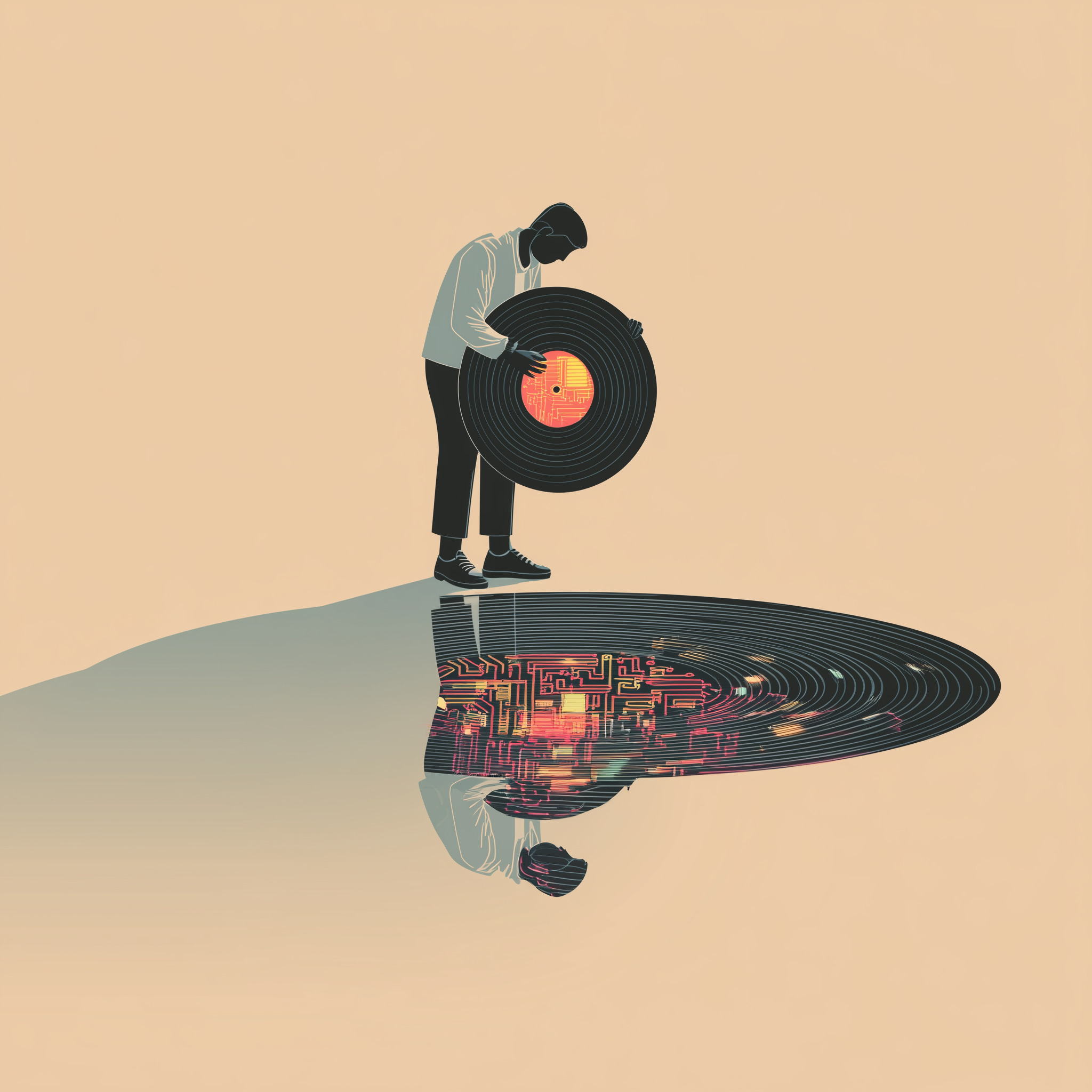
I hadn’t experienced being loathed until Lois tried to teach me how to play the piano. One can only flub the opening section of Vince Guaraldi Trio’s ‘Linus and Lucy’ so many times, obstinately insisting on beginning anew each time, before even the most patient teacher allows their body language (and at times, spoken language) to betray something akin to despair. While some likely have a similar story from their youth, this was a feeling I experienced as a 34 year old. After my first born demonstrated some nascent interest in music at three years old, I took it upon myself to learn to read sheet music, and to experience learning something new for the first time in over a decade.1 I was diligent enough early on to see some progress. A few small wins kept me coming back. Sections would click, then fall apart, then click again somewhere new. Lather, rinse, repeat: for two months. I wanted mastery, but instead found incompetence. And along the way I had an unending desire to get it perfect from the start, never willing to push through minor mistakes beginners make, as though I was disappointing my audience of one (Lois) each week.
Ultimately, I had established a baseline understanding, which was enough to satiate my desire to learn and to support my young son as he started his music journey.2 But the realities of time and the responsibilities of work and parenting prohibited further growth. Carving out practice time each week became increasingly difficult. My piano journey ended shortly thereafter. Crucially however, I didn’t stop because of my incompetence. Indeed, I often reveled in that feeling. I did not have a resistance to incompetence. I had a resistance to the inefficiency of not having a piano in my home.
You Don’t Know What You Really Want
I share the above story, because I see significant parallels in how many adults think when trying to learn about generative AI. In my experience, many adults possess a resistance to feeling incompetent, even briefly. This is understandable. No one likes feeling incompetent. It is uncomfortable and disorienting—but when tasked with navigating the complexities of this reality in educational settings, the second order effects compound in ways that do a disservice to those in our care. Harvard Law professor Noah Feldman shared his feelings with unusual honesty on his Substack, writing, “I’m telling myself I have to learn how to do this new thing, even if I’m not doing it at the highest level.”
There are many ways one might learn this new thing, but the critical aspect that many miss is that every thing you do offers an opportunity to learn. You needn’t reserve time in AI practice rooms, as I did, to learn the piano. Nor do you need to buy a piano and wedge it into your home. While there are many courses or tutorials one might engage with, simply opening your preferred LLM and inviting it into a workflow immediately illuminates areas of potential use. The piano practice room comes to you. And in doing the work, you’re essentially engaging in the kind of play that leads to learning. You will likely make mistakes (as will the LLM) but the barriers to improvement are almost always self-imposed. Which brings me back to Lois. Lois wasn’t loathing because I made mistakes. She was loathing because I was unwilling to make the mistakes necessary to learn. I was stuck inside of myself in a way that served absolutely no purpose. Perfection was never the goal. Learning was.
Everybody Thought I Was Crazy
I sat in a high rise office suite in New York City in the spring of 2023 surrounded by tech bros and Silicon Valley types—people whose world felt nothing like a classroom—and who turned out to understand where classrooms were headed better than most educators did. I left alarmed by the coming tsunami that has largely come to fruition over the last two plus years.3 The question was never whether AI would arrive in classrooms. It has. The harder question is what we risk losing if we let it do the cognitive work that builds the very knowledge students need to use it well. And for schools, I continue to struggle with the very nature of knowledge in these times. What does it mean to know something in the age of AI? How might schools ensure that students continue to accumulate rich, durable knowledge that allows them to leverage these tools with real power?

Where I’ve landed, for now, looks something like this: Students don't need another tutorial on how to use an LLM. They need to watch a history teacher think through a primary source with one. Or a biology teacher interrogate a dataset. Or an English teacher push back on an AI-generated argument. And, with appropriate scaffolding, they too need to engage in these practices to inform their own growth. Tools like NotebookLM are already informing the work of historians.4 Leading mathematicians are leaving the academy to work with AI startups to help solve problems that humans have wrestled with for centuries. The nature of work, and of learning, seems to be evolving to such an extent that to ignore these realities would be equivalent to sticking our head in the sand. This is further compounded by the fact that we’ve organized the sand, and given it electrical charges, in such a way that it replicates so many of the very things we’ve asked of students in schools.5
There are no blueprints here. There is only learning. Some of that learning will not pan out into actionable practice, but some of it will. The only way we’ll get there is by a genuine willingness to play the notes. Mistakes and all.
Note: I always pull blog titles, and often section headings, from song titles or lyrics. It's a thing. It's fine. Just go with it. I named the blog 'The Academic DJ' after all.
Today's title comes from LCD Soundsystem's 'Losing My Edge.' It's apt, to say the least. I routinely feel like I've lost my edge. AI does many things far better than me. But James Murphy wrote the song as a kind of love letter to the people who showed up first; the ones who were there before it was obvious. I like to think that's still worth something.
This is not entirely true. I took up cycling in my early 20s and progressed relatively quickly from a flabby amateur to a slightly less flabby, and somewhat more accomplished, amateur cyclist, winning the (very) occasional race and gaining enough points to level up along the way. My understanding of that growth process could have applied to my piano learning, but like many things in life, I was too blind to see it at the time.
Now 11, he plays the trombone. Reader? Not great! But he also performs in theatre and musicals and clearly has a good ear and wants to take up the guitar soon.
This is not an endorsement. It was simply clear to me in the moment, that when the ed-tech community aimed it’s never-ending money cannon at classrooms, that things were going to change. Like many, I often long for the halcyon days of years past. But they’re mostly gone and they aren’t coming back. By all means we should preserve them in certain pockets. We just can’t preserve them in every pocket.
I’ve started an intellectual side project in this regard, dumping my research from Zotero, cultivated during my Masters thesis in Atlantic History nearly 15 years ago, into NotebookLM. I’m rewriting that thesis, and expanding my research, thanks to the tool.
This is a joke, but also not. Silicon, the material inside every chip powering every LLM you've ever used, is, at its most basic, highly organized sand. We have, quite literally, arranged grains of the earth into something that can write an essay, solve a proof, and generate a lesson plan. If that doesn't reframe the conversation about what schools are for, I'm not sure what will.
Well written, scholar.
If an adult must learn, learning to play music is such a fabulous choice.